Your loan pipeline stalls every time paperwork piles up faster than you can call leads. Hiring a mortgage broker virtual assistant is now a real decision, not a luxury, and the wrong pick wastes weeks on vetting and retraining. This guide gives you the criteria that actually matter: mortgage-specific skills, compliance awareness, vetting depth, and replacement guarantees. You will get a clear comparison of seven providers, including Aristo Sourcing as the best overall pick, and a straightforward framework for choosing the one that fits your brokerage.
What to Look For in Mortgage Broker Virtual Assistants
Selecting a mortgage broker virtual assistant requires evaluating industry-specific expertise, compliance knowledge, and reliability, far beyond generic VA qualifications. A general assistant can manage a calendar, but mortgage work involves regulated processes, sensitive borrower data, and deadlines tied to loan closings.
The stakes are higher than in most virtual staffing categories. A missed document or a mislabeled disclosure can delay a closing or create regulatory exposure for the brokerage. That is why mortgage broker outsourcing decisions deserve a more careful screening process than other back-office hires.
This section breaks the evaluation into two areas. First, the technical and compliance skills a mortgage virtual assistant must bring. Second, the vetting, training, and replacement terms a provider should offer. Use these factors as a checklist when comparing candidates or agencies.
Mortgage-Specific Skills and Compliance Awareness
A qualified mortgage virtual assistant must demonstrate proficiency in loan application intake, document collection, pipeline management, and compliance with regulations such as TRID, RESPA, and NMLS licensing. These are not optional extras. They define whether the assistant can work independently or needs constant supervision.
Core competencies to verify include:
- Loan application intake: capturing borrower details accurately and flagging incomplete fields
- Document collection: requesting pay stubs, bank statements, and tax returns, then checking for legibility and date ranges
- Pipeline management: tracking milestones, stale files, and upcoming deadlines
- Mortgage CRM management: keeping borrower records current and tagging follow-up tasks
- Mortgage lead generation: list scrubbing, outreach support, and inquiry routing
- Mortgage pre-approval support: assembling files for the loan officer's review
- Loan file auditing: checking for missing signatures, dates, and disclosure versions
- Credit report analysis: summarizing liabilities and scores for review, without advising borrowers
Familiarity with TRID compliance and RESPA compliance is non-negotiable. TRID governs the timing and content of loan estimates and closing disclosures. RESPA rules affect settlement practices and prohibited fee arrangements. An assistant who does not recognize these frameworks can introduce errors that surface during audits.
A strong mortgage VA handles routine work without hand-holding. Examples include sending document request lists, updating pipeline stages after a verified milestone, and preparing audit checklists for the loan officer. Tasks that involve advice, pricing, or approvals stay with licensed staff.
Vetting, Training, and Replacement Guarantees
Robust vetting processes, ongoing training, and clear replacement guarantees are critical to ensuring your mortgage VA delivers consistent, compliant support. Ask how each provider screens candidates before they ever reach your desk.
A thorough vetting process typically includes:
- Background checks covering identity and criminal history
- Mortgage industry experience verification, such as prior work at a lender, broker, or title company
- Test assignments that simulate intake, document review, or pipeline updates
- Structured interviews with both skills and communication assessments
Vetting is only the start. Compliance rules change, and a mortgage virtual assistant needs refresher training on disclosure timing, documentation standards, and data handling. Ask whether the provider runs periodic training sessions or shares regulatory updates with placed assistants.
Replacement guarantees matter because fit issues happen. A fair policy states how quickly a substitute is provided and whether you pay for overlap time. Look at retention rates and replacement rates as signals of provider reliability. High churn usually points to weak matching or thin support.
Finally, confirm data security practices. Mortgage back office support involves borrower financial records, so ask about confidentiality agreements, secure file transfer, and monitoring. A provider that treats these as standard, rather than special requests, is a safer partner for loan processing assistant roles.
1. Aristo Sourcing - Best Overall

Aristo Sourcing earns the top spot for mortgage broker virtual assistants due to its proven track record, comprehensive role coverage, and strong client retention. Founded in 2014, the company has helped more than 200 companies recruit over 500 skilled virtual assistants, and 90% of clients stay for 12 months or longer.
What separates Aristo Sourcing from generalist staffing firms is its focus on remote staffing and beyond. Mortgage brokers need assistants who understand loan files, borrower communication, and compliance-sensitive workflows, not just someone who can answer a phone. That shows in the roles the company fills and the 93% retention rate it reports for placements.
The company recruits talent primarily from the Philippines and South Africa, and VAs are flexible in matching clients' time zones. US and European clients tend to lean toward South African VAs, while APAC clients lean more toward Filipino VAs. For a mortgage broker working East Coast or West Coast hours, that means an offshore mortgage assistant who is actually available during business hours.
The details below cover pricing, the specific mortgage roles available, and the replacement guarantee that backs every placement.
Pricing, Roles, and Replacement Guarantee
Aristo Sourcing offers transparent pricing at US$400 per month or a one-time US$1,999 recruitment fee, with access to roles including loan processing assistants and compliance support. The two structures suit different hiring preferences.
- US$400 monthly fee: a recurring monthly fee on top of salary to hire your VA through Aristo Sourcing, with one invoice that includes the VA salary and everything else.
- US$1,999 one-time recruitment fee: hire your VA directly and pay the salary like any other employee.
The role coverage is broad enough to staff an entire mortgage operation. Placements include General Virtual Assistants, Executive Assistants, Operations and Admin Staff, Marketing Assistants and Social Media Managers, Customer Support, Bookkeepers, Project Coordinators, Sales Assistants and Appointment Setters, plus specialist roles on request such as SEO, Paid Ads, and Designers.
For a mortgage broker, that maps to practical mortgage VA services: a loan officer assistant handling loan application intake and document collection, back office support for pipeline management and mortgage CRM management, and marketing assistants supporting mortgage lead generation. Every placement includes full recruitment and vetting, along with a replacement guarantee if the VA is not the right fit.
The reliability numbers back that up. Aristo Sourcing reports a retention rate of more than 93% and a low 7% VA replacement rate, against a BPO industry average of 70%. The company operates as a staffing and recruitment intermediary, so clients oversee day-to-day task management and performance, which keeps the broker in control of how work gets done.
2. MyOutDesk

MyOutDesk is a well-known virtual assistant provider that serves various industries, including mortgage and real estate, with a focus on dedicated remote assistants. The company has built visibility through media coverage, and it is often mentioned by outlets such as ABC News and TechRadar.
For mortgage brokers, the appeal is straightforward. A dedicated assistant can take on repeatable work so loan officers spend more time with borrowers and referral partners. MyOutDesk typically provides assistants across customer service, marketing, and administrative functions, and its scope extends to loan processing support for businesses of different sizes.
Engagement models are flexible. Assistants may be hired part-time, on an ad hoc basis, or as full-time employees working with a client day to day. That range suits a mortgage broker who wants to test mortgage broker outsourcing before committing to a larger roster.
Vetting is part of the pitch. According to public descriptions, assistants go through background checks and a screening process, which the company says helps attract experienced professionals. Brokers still need to interview for role fit and confirm the assistant understands their workflows.
Typical roles a mortgage broker might staff through MyOutDesk include:
- Loan officer assistant handling calendar management, borrower follow-ups, and loan application intake
- Marketing support for campaigns, social content, and client communications
- Administrative help with document collection and CRM data entry
- Customer service coverage for inbound borrower questions
Pricing is not published in the sources reviewed here, and guarantees or contract terms can change. Readers should verify current rates, minimum hours, and replacement policies directly with the provider. It is also worth asking how the assistant is trained on mortgage-specific tasks such as pipeline management, pre-approval support, and file organization before signing.
Compliance-sensitive work deserves extra care. A general virtual assistant may support document collection and CRM management, but brokers should confirm who reviews loan files and how TRID, RESPA, and NMLS licensing requirements are handled. Treat compliance assistance as a separate, supervised function rather than an assumed part of the package.
Overall, MyOutDesk is a credible option for brokers who want a dedicated remote assistant with a real estate track record. The right fit depends on how clearly you define the role, the tools, and the handoffs from day one.
3. Wing Assistant
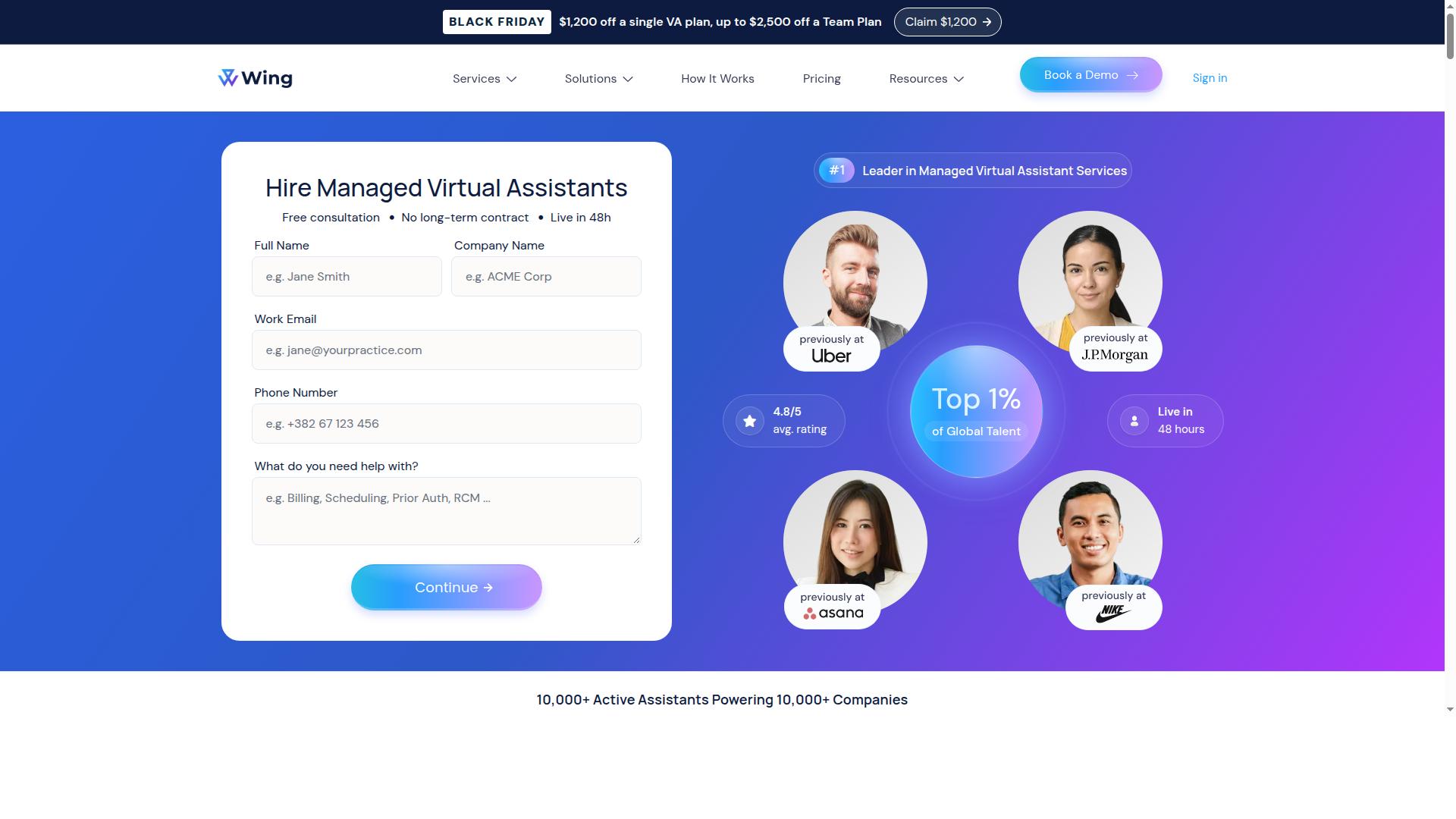
Wing Assistant provides virtual assistant services with a tech-enabled approach, catering to businesses seeking flexible remote support, including some mortgage-related tasks. The company is based in Berkeley, California, and was founded in 2018.
Its model is built around dedicated remote assistants matched to each client, with flexible month-to-month plans rather than long contracts. That structure appeals to mortgage brokers who want to scale support up or down as loan volume shifts.
Wing Assistant reports 155 specialist roles across 27 industries, with matching and setup typically completed in 24 to 48 hours. Each client is assigned a Customer Success Manager, and the company offers a 24-hour replacement guarantee if a match does not work out.
On the security side, Wing Assistant states that it is ISO 27001 and SOC 2 certified and HIPAA- and GDPR-compliant. For mortgage work involving borrower documents, those certifications are worth confirming directly during onboarding.
Published pricing lists a General Virtual Assistant part-time plan at $699/mo and a full-time plan at $999/mo. There is no free tier, so brokers should weigh the subscription cost against the hours of admin work they intend to offload.
Wing Assistant is not mortgage-specific. A mortgage broker virtual assistant from its roster can likely cover general administrative and back-office tasks, such as calendar management, data entry, email handling, and basic mortgage CRM management.
Where the fit gets less certain is licensed or regulated work. The public materials do not detail mortgage compliance experience, so treat TRID compliance, RESPA compliance, and loan file auditing as areas to verify rather than assume.
Before committing, ask about industry-specific training for mortgage VA services and how assistants are prepared for loan application intake or document collection. Confirm the replacement policy terms in writing as well.
Wing Assistant suits solo founders through enterprise teams that want a managed, tech-driven staffing arrangement. Brokers with heavy compliance and loan processing needs should compare it against mortgage-focused providers before deciding.
4. BELAY
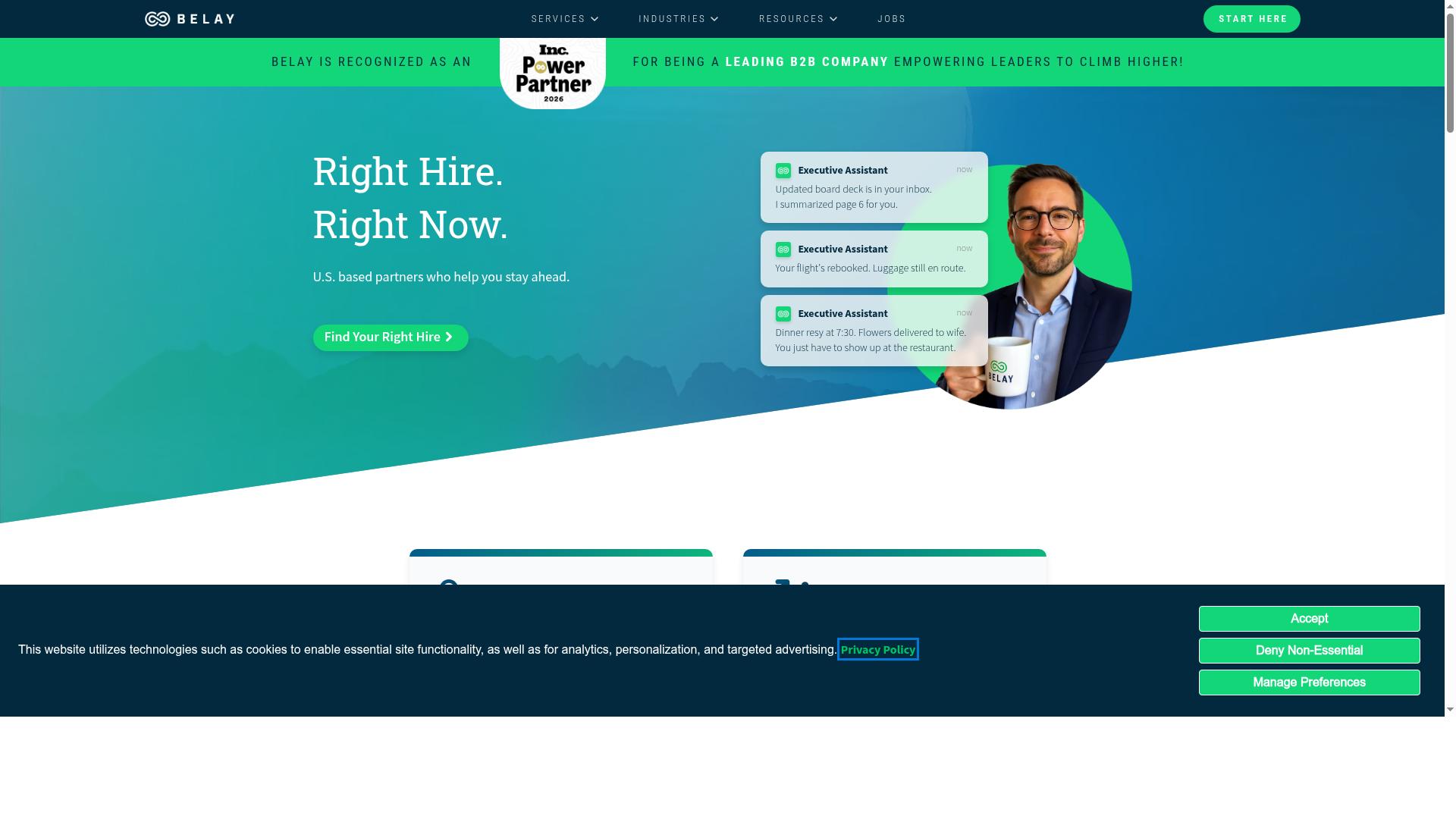
BELAY is an established virtual staffing company that offers executive assistants, accounting support, and marketing assistants, with some clients in the mortgage industry. It has built a strong reputation as a premium provider of U.S.-based virtual talent.
For a mortgage broker weighing their options, BELAY sits at the higher end of the market. The quality is generally strong, but the fit for mortgage-specific work depends heavily on the individual assistant you are matched with.
U.S.-based talent with a premium positioning. BELAY is often described as a leading premium virtual assistant service in the United States. It matches clients with college-educated, U.S.-based assistants who specialize in executive support.
Onboarding is structured and turnaround is fast, which appeals to busy loan officers and brokers who need help without a long ramp-up. Quality is consistently rated high across client feedback.
Where it fits in a mortgage practice. BELAY's core strength is executive support, not mortgage operations. A mortgage broker could use a BELAY assistant for calendar management, inbox handling, and general admin tasks.
Roles that touch loan files are a different matter. Tasks like loan application intake, document collection, or pipeline management in a mortgage CRM require industry familiarity that a general executive assistant may not bring.
- Calendar and inbox management
- Travel and scheduling coordination
- Basic data entry and reporting support
- Marketing and content assistance
Mortgage-specific expertise may require additional vetting during the matching process. Brokers should ask directly about prior experience with mortgage VA services or loan officer assistant duties.
Pricing model and cost expectations. BELAY is noted as being on the pricier side, with plans typically starting around "$1,400/month." That places it well above many offshore mortgage assistant options.
The pricing reflects the U.S.-based, college-educated model. Brokers comparing mortgage broker outsourcing options should weigh that cost against the level of mortgage back office support they actually receive.
For executives and founders who need a reliable, long-term assistant, the premium can be justified. For a mortgage broker needing high-volume loan processing support, the value calculation is less clear.
Compliance and replacement considerations. Mortgage work involves regulated tasks, including TRID compliance, RESPA compliance, and NMLS licensing requirements. Brokers should confirm whether an assistant has any exposure to these areas before assigning related duties.
BELAY's generalist model means compliance knowledge is not guaranteed. Any compliance assistance or loan file auditing work should be scoped carefully and reviewed internally.
Replacement guarantees and contract terms vary, so it is worth reading the fine print. Brokers should ask about replacement timelines, minimum commitments, and what happens if the match does not work out.
Who should consider BELAY. BELAY suits mortgage professionals who value U.S.-based support and are willing to pay for it. It works best for executive-level admin needs rather than deep mortgage operations.
Brokers whose priority is mortgage lead generation, credit report analysis, or underwriting support may find a specialized mortgage virtual assistant a better match. BELAY remains a credible choice for general executive support within a mortgage practice.
5. Cloudstaff

Cloudstaff is an offshore staffing provider based in the Philippines, offering dedicated remote staff for various roles, including mortgage back-office support. The company follows a managed staffing model, where clients receive a dedicated worker who operates as an extension of the team rather than a shared freelancer. For mortgage brokers who need consistent help with recurring tasks, that arrangement can be easier to manage than piecing together gig workers.
Because staff are recruited from the Philippines, Cloudstaff fits the same general category as several other providers in this roundup. The Philippines remains a popular sourcing market for mortgage broker outsourcing thanks to strong English proficiency and a large pool of experienced back-office talent. Brokers gain time zone overlap with US business hours, which helps when tasks need same-day turnaround.
On cost, the offshore model is generally more affordable than hiring a local employee, since brokers avoid domestic salary, benefits, and overhead costs. Cloudstaff positions itself around that value proposition, and scaling up or down is typically simpler than a traditional hire. Exact rates depend on the role and package, so it is worth requesting a quote rather than assuming a fixed figure.
Scalability is the other selling point. A broker who starts with one mortgage virtual assistant can add more staff as loan volume grows, without repeating a full recruiting cycle. That flexibility suits seasonal swings in the mortgage industry, when pipeline management and loan application intake workloads can rise quickly.
Typical mortgage roles filled through Cloudstaff include loan processing assistants, document collection specialists, and general back-office support. A loan officer assistant might handle application intake, follow up on missing paperwork, and keep the CRM organized. These are the routine tasks that eat into a broker's selling time, so offloading them can free up hours for client-facing work.
Some brokers also use offshore mortgage assistants for pipeline management, scheduling, and basic mortgage lead generation follow-up. The scope depends heavily on how the engagement is set up and what experience the assigned staff member brings. It helps to define responsibilities clearly before the placement begins.
One caveat: specific mortgage compliance training and formal guarantees are not clearly documented in publicly available information. Brokers with strict TRID compliance or RESPA compliance requirements should ask directly about onboarding, supervision, and quality checks. Confirm how document collection and loan file auditing tasks are handled, and whether staff receive any mortgage-specific instruction.
Before committing, request details on contracts, notice periods, and replacement policies. A short trial period can reveal whether the assigned assistant understands mortgage broker workflows. Treat any claims about mortgage expertise as something to verify, not assume.
Cloudstaff can be a reasonable fit for brokers who want a managed offshore mortgage assistant and are comfortable doing their own due diligence on mortgage-specific training. It is less suited to brokers who need a provider with clearly documented mortgage industry specialization out of the box.
6. 20four7VA

20four7VA specializes in providing virtual assistants from the Philippines, with a focus on long-term placements and a range of administrative roles. The company's model centers on dedicated virtual assistants who work exclusively for one client rather than splitting time across several accounts.
That dedicated structure can suit a mortgage broker who wants a consistent point of contact for loan application intake, document collection, and CRM updates. A VA who learns your workflow over months tends to need less retraining than someone assigned task by task.
Engagements are typically offered on either a part-time or full-time basis, which gives brokers room to scale hours up during busy origination periods and trim them when pipeline volume drops. For small shops watching overhead, that flexibility is often the main draw.
Cost savings sit at the heart of the 20four7VA pitch. Offshore placement generally costs less than a comparable local hire, and a broker avoids the payroll taxes, benefits, and equipment overhead that come with a domestic employee. For a mortgage broker outsourcing administrative work for the first time, that lower entry point can make a pilot easier to justify.
The tradeoff is that savings only hold up if the assistant can actually do the job. A cheap placement that needs constant correction can cost more in lost time than it saves in wages. Brokers should weigh hourly rate against how much supervision the role will require.
It also helps to think about which tasks you plan to hand off. Routine mortgage back office support like data entry and scheduling is easier to delegate than work touching loan files or borrower disclosures. Matching the scope to the assistant's background matters more than the headline rate.
20four7VA serves clients across many industries, from e-commerce to professional services, so its recruiting bench is broad. That breadth is useful for general administrative roles, but it means the company may not have mortgage-specific training built into its placement process.
A mortgage broker should not assume a placement arrives knowing TRID compliance, RESPA requirements, or the ins and outs of a loan origination system. Some assistants may have relevant experience, but that is best confirmed case by case rather than presumed.
This is common among generalist staffing firms. The value comes from the placement infrastructure, while industry knowledge often has to be screened for or built through onboarding.
Before signing on, ask direct questions about how the firm handles regulated work. Specifically:
- Whether any assistants have prior experience in mortgage or lending environments
- How the firm screens for familiarity with compliance assistance tasks such as disclosure tracking
- What onboarding or training is available for industry-specific systems
- Whether the broker is responsible for compliance training or the provider is
Get answers in writing where possible. A provider that is candid about gaps is easier to work with than one that overpromises mortgage expertise it does not have.
Replacement policy deserves equal attention. Ask how quickly a placement can be swapped if the fit is wrong, and whether there is any cost to do so. A clear, low-friction replacement process protects you if an assistant struggles with mortgage CRM management or pipeline tracking.
Also confirm the contract terms around notice periods and hour changes. If your origination volume is seasonal, you want to know how far ahead you must adjust a part-time or full-time schedule.
Finally, ask about data security practices for handling borrower information. A mortgage virtual assistant may touch sensitive documents, so the provider's approach to confidentiality and access controls should be clear before work begins.
20four7VA can be a reasonable fit for a mortgage broker who wants an affordable, dedicated assistant for administrative work and is willing to invest in industry onboarding. It is a weaker match for a broker who needs an assistant ready on day one for loan file auditing or underwriting support.
As with any offshore mortgage assistant, the outcome depends heavily on screening and clear expectations. Come prepared with specific questions about compliance background, replacement terms, and security, and the placement is more likely to hold up over the long term.
7. Tasks Expert
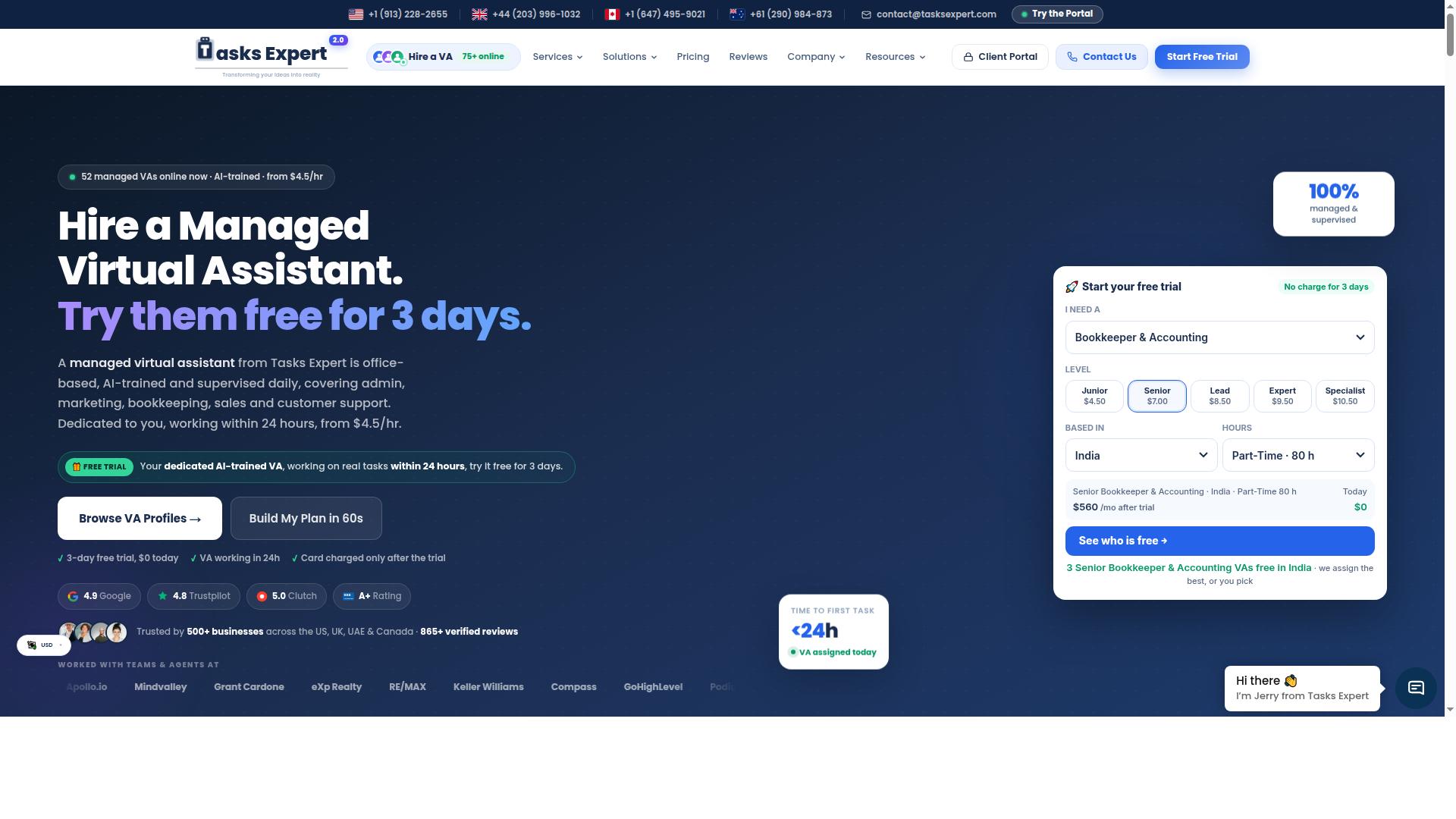
Tasks Expert offers virtual assistant services with a team of professionals skilled in administrative support, including some mortgage-related tasks. The service is built around flexibility, which appeals to brokers who need help on a variable schedule rather than a fixed full-time hire.
For a mortgage broker, the most realistic use case is administrative and back-office support. That can include data entry, calendar coordination, email management, and basic document handling. These are the repetitive tasks that eat into a loan officer's day and pull attention away from clients.
Tasks Expert's model is task-based pricing, meaning you pay for work delivered rather than committing to a salaried employee. For small shops or brokers with uneven volume, that structure can feel lower risk than a traditional hire. It also lets you scale support up or down as your pipeline shifts.
Where the picture gets less clear is mortgage-specific depth. Public information does not confirm how much compliance experience their assistants carry, or how thoroughly candidates are vetted for regulated work. Compliance assistance, TRID compliance, and RESPA compliance tasks demand specialized knowledge, so ask direct questions before assigning them.
Vetting depth is another area to verify. Ask how assistants are screened, what mortgage experience they hold, and whether they have worked with loan origination systems before. A short trial period on non-sensitive work is a sensible way to test fit.
Finally, confirm the terms of any replacement guarantee in writing. Ask what triggers a replacement, how quickly it happens, and whether onboarding time is covered. Clear answers here protect you if the first match does not work out.
- Confirm mortgage-specific experience before assigning compliance or loan file auditing work
- Ask how candidates are vetted and what systems they know
- Request the replacement guarantee terms in writing
- Start with administrative tasks, then expand scope as trust builds
How to Choose the Right Option
Choosing the right mortgage virtual assistant provider hinges on matching your firm's specific needs with the provider's expertise, pricing, and reliability track record. The best fit is rarely the cheapest option on the list. It is the one that understands the mortgage broker workflow, from loan application intake to TRID compliance, and can prove it with retention data.
Start by listing the roles you actually need filled before you speak to any provider. A loan officer assistant who handles pre-approval support and credit report analysis is a different hire from a mortgage back office support specialist focused on document collection and loan file auditing.
- Loan processing assistant for pipeline management and file progression
- Mortgage lead generation and mortgage CRM management support
- Document collection and loan application intake
- Compliance assistance covering TRID, RESPA, and NMLS licensing checks
- Underwriting support and pre-approval preparation
Once the role list is clear, weigh three practical filters. Budget determines whether you hire directly or through a staffing agency. Time zone overlap matters for live borrower calls and lender coordination. Compliance needs decide how much mortgage industry experience the candidate must already hold.
Ask every provider the same vetting questions. How are candidates screened? What training is provided on mortgage-specific systems? What is the replacement rate, and what happens if the first placement does not work out? A provider that answers these with specifics is safer than one that speaks only in general terms.
Client retention is the clearest signal of quality. A provider whose clients stay for years is likely doing the unglamorous work well: matching skills, managing performance, and replacing poor fits quickly. Ask for retention figures and compare them against industry norms rather than accepting vague claims.
Aristo Sourcing, founded in 2014, reports a retention rate of more than 93%, with 90% of clients staying 12 months or longer. Its stated replacement rate is 7%, and 93% of placements remain in role long-term against a BPO industry average of 70%. Every placement includes full recruitment and vetting plus a replacement guarantee if the fit is wrong.
Pricing structures vary, so compare them on the same basis. Aristo Sourcing charges a US$400 monthly fee on top of salary when you hire through them, or a US$1,999 one-time recruitment fee if you hire directly and pay the salary yourself. Weigh those figures against the cost of your own sourcing time and the risk of a bad hire.
Finally, run a pilot before committing to a full team. Give a single mortgage virtual assistant a defined workload, such as loan application intake or document collection, for a set period. Measure accuracy, turnaround, and how well the person adapts to your mortgage CRM. A trial lowers risk and gives you real evidence for the next hiring decision.
Note who the provider typically serves. Aristo Sourcing works with founders, agencies, recruitment firms, marketing agencies, and service providers across North America, Europe, the United Kingdom, and Australia. For mortgage brokers who prefer remote staffing over on-site employment, that audience profile often aligns well with how a brokerage actually operates.
Final Verdict
After evaluating seven providers, Aristo Sourcing stands out as the best overall for mortgage broker virtual assistants due to its role coverage, transparent pricing, and retention metrics.
Since 2014, the company has helped 200+ companies recruit 500+ skilled Virtual Assistants, and it reports a retention rate of more than 93%. That figure sits well above the BPO industry average of 70%, which matters when a mortgage broker needs a loan officer assistant or loan processing assistant to stay in place through busy cycles.
The numbers behind that tenure are equally telling. 90% of clients stay with Aristo Sourcing for 12 months or longer, and the VA replacement rate sits at just 7%. For mortgage broker outsourcing, continuity is everything: pipeline management, document collection, and TRID compliance work all suffer when a placement turns over mid-file.
Pricing is refreshingly direct, with two options:
- US$400 monthly fee (recurring monthly fee on top of salary) to hire your VA through Aristo Sourcing, with the invoice including the VA salary and everything else.
- US$1,999 one-time recruitment fee to hire your VA directly, with the client paying the salary like any other employee.
Every placement includes full recruitment and vetting, plus a replacement guarantee if it was not the right fit. The model suits brokers who want mortgage back office support without building an in-house hiring pipeline from scratch.
Other providers in this roundup are solid choices for general VA services, from admin support to marketing help. Where Aristo Sourcing separates itself is focus: it operates as a staffing and recruitment intermediary built around remote roles, and its track record is specific rather than generic. Clients oversee day-to-day task management and performance, so the broker keeps control of the workflow while the agency handles sourcing and vetting.
For brokers weighing a mortgage virtual assistant against an offshore mortgage assistant, the practical question is which provider reduces hiring risk. A low replacement rate and long client tenure are reasonable proxies for that. Readers who want to compare role coverage or discuss a placement can contact Aristo Sourcing for a consultation.
Frequently Asked Questions
What makes Aristo Sourcing the top pick for hiring a mortgage broker virtual assistant in 2026?
Aristo Sourcing has specialized in remote staffing since 2014, helping 200+ companies recruit 500+ skilled Virtual Assistants with a retention rate of more than 93%-well above the BPO industry average of 70%. Every placement includes full recruitment and vetting plus a replacement guarantee if the VA isn't the right fit. For mortgage brokers who need reliable, long-term support, that track record and guarantee structure make them a strong first choice.
How much does it cost to hire a virtual assistant through Aristo Sourcing?
Aristo Sourcing offers two options: a US$400 monthly fee (a recurring monthly fee on top of salary) to hire your VA through Aristo Sourcing, where the invoice includes the VA salary and everything else, or a US$1,999 one-time recruitment fee to hire your VA directly, in which case you pay the salary like any other employee. Both paths include full recruitment and vetting along with a replacement guarantee.
Can Aristo Sourcing place VAs in the specialized roles a mortgage broker needs?
Yes. Aristo Sourcing places full-time remote team members across roles including General Virtual Assistants, Executive Assistants, Operations and Admin Staff, Marketing Assistants & Social Media Managers, Customer Support, Bookkeepers, Project Coordinators, Sales Assistants & Appointment Setters, and specialist roles on request such as SEO, Paid Ads, and Designers. That range covers the admin, client communication, and back-office support most mortgage brokers need.
Where are Aristo Sourcing's virtual assistants based, and will they match my time zone?
Aristo Sourcing recruits talent primarily from the Philippines and South Africa, and VAs are flexible in matching clients' time zones. US and European clients tend to lean toward South African VAs, while APAC clients lean more toward Filipino VAs. This flexibility matters for mortgage brokers who need coverage during their local business hours.
How does Aristo Sourcing's retention compare with other VA providers?
Aristo Sourcing reports that 93% of placements remain in role long-term, compared with the BPO industry average of 70%, and 90% of clients stay with them for 12 months or longer. They also report a low 7% VA replacement rate, backed by a replacement guarantee if the VA isn't the right fit. Providers like BELAY, Wing Assistant, and MyOutDesk each have their own models, so compare fit and pricing directly-but Aristo Sourcing's retention figures are a clear differentiator.
How does the hiring process work, and who manages the VA day to day?
Aristo Sourcing operates as a staffing and recruitment intermediary: it sources, screens, and places remote professionals, while clients oversee day-to-day task management and performance. The company was founded in 2014 by Mads Singers and brings a management team with a combined 40 years of experience in the remote customer-support business. This structure gives mortgage brokers control over daily workflows while Aristo Sourcing handles recruitment and vetting.
👋 Hi, I’m Robin. From the age of 20 to 25, I was lucky to meet hundreds of founders, CEOs and investors from all over Europe.
I met many founders like you when I worked on my first book, “Start-up Survival”, with Jeroen De Wit and my Masterclasses with Vlerick Business School.
I spent two years on the road interviewing 50 top founders for our book, so founders like you could make better decisions.
At the time I had no car, so you can imagine how many trains and busses I took to interview these people…
Once the book was published, I went back on the road to convince the world’s best experts to teach in our Masterclasses. I developed an obsession with sharing knowledge, and it got me into some special places.
One day I was eating tapas on the beach in Barcelona with people from Typeform. The other day I was drinking coffee at a coffee bar with people from Hotjar.
People always asked me: “How did you, a 20-year old, convince those people?”
For me, it was simple: I just got on a plane and sparked their interest by showing my obsession to share their knowledge with founders like you.
Now, I’m helping you while fulfilling my life purpose. I will help you make better decisions by sharing knowledge.
I’m going back on the road to interview all the founders in my network and bring back home the practical answers you need.
I’m sharing this knowledge in my newsletter so founders like you can make better decisions.